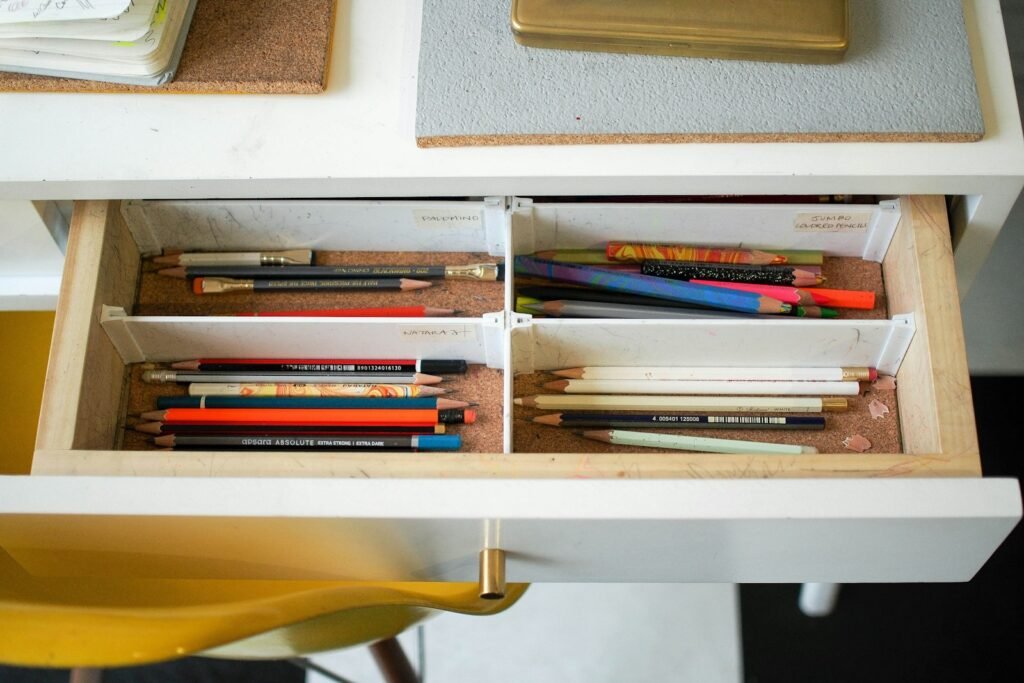
A junk drawer full of loose staples, cables, and spare batteries makes finding anything a search-and-dig job. By the end of this guide, you’ll have a drawer organizer set up so every small item has a fixed compartment, and you can find what you need without emptying the whole drawer onto your desk.
What You’ll Need
- A drawer organizer set sized to your drawer — a multi-piece set like the Vtopmart 25 PCS Clear Plastic Drawer Organizer Set lets you mix and match compartment sizes
- A single adjustable tray like the Simple Houseware Drawer Organizer Tray if you want one fixed layout
- A tape measure to confirm your drawer’s interior dimensions
- 15-20 minutes to sort and arrange the drawer’s contents
Step-by-Step Instructions
Step 1: Empty the drawer completely
Take everything out and set it on your desk so you can see the full range of items you’re organizing — pens, paper clips, cables, adhesive tape, whatever has accumulated.
Step 2: Measure the drawer’s interior before buying
Interior length, width, and depth determine which organizer size or combination of compartments will actually fit — measure before ordering rather than guessing from the drawer’s outer dimensions.
Step 3: Group items into categories by size and use
Small items (paper clips, pins, USB drives) need small compartments; bulkier items (tape, notepads, chargers) need larger ones. Group by category first, then match categories to compartment sizes.
Step 4: Arrange compartments so frequent items sit at the front
Put whatever you reach for most — pens, sticky notes, a charging cable — in the compartments closest to the front of the drawer, and less-used items toward the back.
Step 5: Return only what belongs, and toss or relocate the rest
This is the point to get rid of dead batteries, dried-out markers, and anything that doesn’t have an obvious category — a drawer organizer works best with less total stuff, not more.
Tips for Best Results
- Measure before buying — a set that’s slightly too large for your drawer won’t sit flat
- Clear plastic compartments make it easier to see contents at a glance versus opaque materials
- Adjustable dividers are worth the extra cost if your drawer holds an unusual mix of item sizes
- Do a quick declutter pass every few months — drawers refill with loose odds and ends over time
Common Problems
The most common issue is buying a fixed-compartment tray that doesn’t match what you actually need to store, leaving odd-shaped items with nowhere to go. An adjustable divider system solves this by letting you resize compartments as your storage needs change, rather than being locked into someone else’s layout.
Frequently Asked Questions
Should I measure my drawer before buying an organizer?
Yes — always measure the interior length, width, and depth first. A set that’s even slightly oversized won’t sit flat, and one that’s too small leaves wasted space.
Are adjustable drawer organizers worth the extra cost?
If your drawer holds a mix of item sizes, yes — adjustable dividers let you resize compartments instead of being stuck with fixed sections that don’t match your actual items.
How do I decide what goes in a drawer organizer versus somewhere else?
If you reach for it at least occasionally and it’s small enough to fit a compartment, it belongs in the drawer. Bulkier items or things you rarely use are usually better stored elsewhere.
How often should I reorganize a drawer?
A quick check every few months is enough for most home offices — drawers slowly refill with loose odds and ends, and a short declutter pass keeps the system working.
Conclusion
A drawer organizer only works as well as the sorting behind it — matching compartment sizes to your actual items is what makes the difference between a drawer that stays useful and one that turns back into a junk drawer within a month. Ready to upgrade? Check our Best Drawer Organizers guide for a full comparison of top picks.