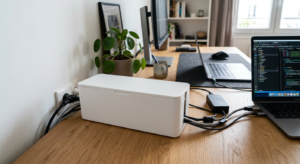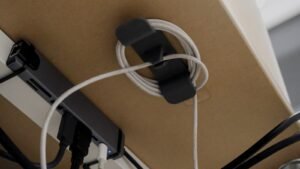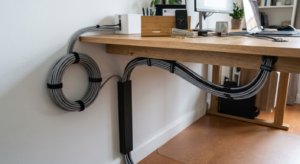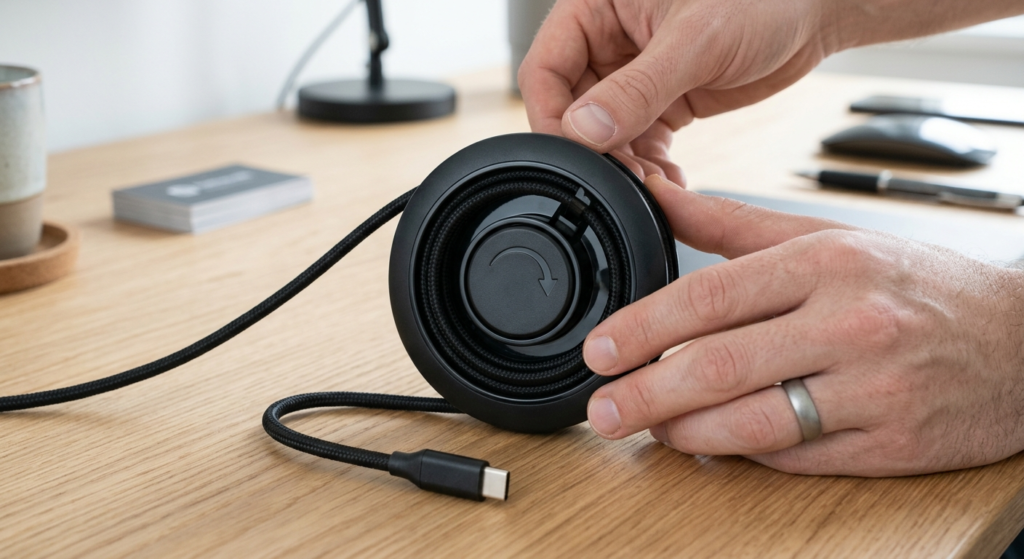
Looking for the best cable winders for your home office? A cable winder takes the extra few feet of slack in a charging cable, HDMI cord, or laptop charger and coils it into a small, tidy bundle instead of a loose loop hanging off the desk. Unlike a clip or tie, a winder lets you unwind exactly as much cable as you need and re-coil the rest in seconds. We read through cable winders reviews and compared the top cable winders for 2026 on capacity, durability, and price. Our top pick is a simple wrap-style winder with a near-perfect rating, but a few other sizes and styles below might suit your specific cables better.
Quick Comparison: The Best Cable Winders at a Glance
Prices shown in CAD, pulled from live Amazon listings — click through for current pricing.
| Product | Rating | Price | Best For | |
|---|---|---|---|---|
| Bobino Cord Wrap, Large (3-Pack) | 4.7★ (80) | CAD 19.57 | Best Overall | Check Price → |
| Bobino Cord Wrap, Medium (3-Pack) | 4.6★ (63) | CAD 18.17 | Best for Everyday Charging Cables | Check Price → |
| ELFRhino Silicone Earphone Organizer | 4.4★ (5,334) | CAD 13.96 | Best for Earbuds / Most-Reviewed | Check Price → |
| Bobino Cord Wrap, Small (3-Pack) | 4.2★ (94) | CAD 16.77 | Best for Thin Cables | Check Price → |
| CABLETTO Cord Wrap Keeper (6-Pack) | 4.4★ (276) | CAD 24.44 | Best Multi-Pack / Value | Check Price → |
| Bobino Cord Wrap, Extra Large | 4.2★ (19) | CAD 12.61 | Best for Thick Cords | Check Price → |
Our Top Picks
1. Bobino Cord Wrap, Large (3-Pack) — Best Overall
This simple silicone wrap coils a laptop charger or monitor cable’s slack into a neat loop that clips shut with its own tail. It carries the highest rating in this list at 4.7 stars, and the 3-pack covers more than one cable from a single order.
| ✅ Pros | ❌ Cons |
|---|---|
| Highest rating in this list at 4.7 stars | Smaller rating sample (80) than the mass-market ELFRhino pick |
| No moving parts to jam or break, unlike spring-loaded winders | Manual wrap takes a few seconds longer than an automatic reel |
| 3-pack covers multiple cables from one order |
Best for: laptop chargers, monitor cables, and other everyday desk cords with a few feet of slack to coil up.
2. Bobino Cord Wrap, Medium (3-Pack) — Best for Everyday Charging Cables
The medium size fits phone chargers, USB cables, and other everyday cords a size down from a full laptop charger. Same simple wrap-and-clip design as the large size, just scaled for thinner, shorter cables.
| ✅ Pros | ❌ Cons |
|---|---|
| 4.6-star rating holds up at a similar sample size to the large version | Too small for a full laptop charger’s worth of cable |
| Sized right for phone chargers and standard USB cables | 3-pack costs nearly as much as the large 3-pack |
| Same reliable no-moving-parts design as the large size |
Best for: phone chargers, USB cables, and other everyday cords that don’t need the large size’s capacity.
3. ELFRhino Silicone Earphone Organizer — Best for Earbuds / Most-Reviewed
With over 5,300 ratings, this is by far the most-reviewed winder in this list. It’s sized specifically for earbud cables and other very thin cords rather than desk cables, and the flat silicone disc slips easily into a pocket or bag.
| ✅ Pros | ❌ Cons |
|---|---|
| 5,300+ ratings — the largest sample by far in this list | Too small for anything thicker than an earbud or thin charging cable |
| Flat, pocket-friendly shape for travel, not just desk use | Single-piece purchase, not a multi-pack like the Bobino sizes |
| Low price for a proven, widely-bought design |
Best for: earbuds and other very thin cables, especially ones that travel in a bag or pocket.
4. Bobino Cord Wrap, Small (3-Pack) — Best for Thin Cables
A step up in size from the ELFRhino but still built for thin cables, the small Bobino suits USB cables and earbuds while keeping the same durable, no-moving-parts wrap design as its larger siblings.
| ✅ Pros | ❌ Cons |
|---|---|
| Same reliable wrap design as the larger Bobino sizes, scaled down | Lower rating average than the large and medium Bobino sizes |
| Suits thin cables the large and medium sizes are too big for | Smaller rating sample than the ELFRhino at a similar price point |
| 3-pack covers multiple thin cables at once |
Best for: thin cables where you want the Bobino brand’s design consistency across multiple cable sizes on your desk.
5. CABLETTO Cord Wrap Keeper (6-Pack) — Best Multi-Pack / Value
CABLETTO ships six winders per order, more than double the Bobino 3-packs, at a price that works out to roughly the same cost per unit. The flexible design bends at both ends to fit the cable rather than relying on a single fixed loop size.
| ✅ Pros | ❌ Cons |
|---|---|
| 6 winders per pack — double the quantity of the Bobino 3-packs | Highest total price of the six, even at a similar per-unit cost |
| Flexible slots adjust to fit different cable thicknesses | Smaller rating sample than the ELFRhino pick |
| Solid 4.4-star average across 276 ratings |
Best for: outfitting a lot of cables at once — a full desk setup, a travel bag, and a backpack, all from one order.
6. Bobino Cord Wrap, Extra Large — Best for Thick Cords
The XL size steps up to handle thicker cords — heavier power cables, kitchen appliance cords, or bundled cable runs — that would overwhelm the large size’s loop. It’s sold as a single unit rather than a multi-pack.
| ✅ Pros | ❌ Cons |
|---|---|
| Handles thicker cords the other sizes in this list can’t manage | Smallest rating sample (19) in this list |
| Sold individually, so you only buy what you need | Sold as a single unit, not a multi-pack like most other sizes here |
| Same durable, no-moving-parts design as the rest of the Bobino line |
Best for: heavier power cords or appliance cables too thick for the standard large Bobino size.
How We Selected These Products
We compared these six based on published product specs, verified Amazon ratings, and each manufacturer’s material claims. One honest finding from that research: the automatic, spring-loaded cord winders we checked consistently rated between 3.0 and 3.6 stars, noticeably lower than every manual wrap-style winder in this list — so we left them out rather than recommend a design that reviewers repeatedly flag as unreliable. Beyond that, we checked:
- Price per unit, not just per pack
- Cable diameter and length capacity
- Material and durability over repeated use
- Verified customer reviews, not just star averages
- Quantity per pack relative to price
Buying Guide: What to Look for Before You Buy
Winder Style: Manual Wrap vs. Spring-Loaded Automatic
Manual wrap-style winders have no moving parts to jam or wear out, which our research suggests is why they consistently out-rate automatic spring reels. Automatic winders retract with one motion, but reviewers frequently report the spring mechanism failing over time.
Size & Cable Thickness
Match the winder to your thickest cable, not your thinnest. A winder sized for earbuds won’t close around a laptop charger, and one sized for a laptop charger will look oversized wrapped around a thin USB cable.
Material & Durability
Silicone and TPE flex repeatedly without cracking, which matters if you’re unwinding and re-coiling a cable daily. Rigid plastic winders are cheaper but can snap at the hinge point after months of regular use.
Capacity
Check how much cable length a winder is actually built to hold. Most handle 2-4 feet of slack comfortably; forcing more into one will strain the design and make it harder to close.
Quantity Needed
Count your cables with excess slack before buying a single unit. Multi-packs cost more upfront but work out cheaper per winder than buying single units one at a time as you notice more cords that need one.
Portability vs. Desk-Bound Use
A flat, compact winder makes sense for a charging cable that travels in a bag. A bulkier winder is fine for a cord that stays clipped to the same spot on your desk permanently.
Common Mistakes to Avoid
- Buying an automatic spring-loaded winder. Our research found these consistently rated 3.0-3.6 stars, with reviewers reporting jamming and spring failure — manual wrap designs rate noticeably higher.
- Sizing to the wrong cable. Match the winder to your thickest cable, or it simply won’t close around it.
- Forcing too much slack into one winder. Overloading a winder beyond its rated capacity strains the design and makes it hard to close.
- Buying one at a time. Multi-packs cost less per winder than buying single units as you notice more cords that need one.
How to Set Up Your Cable Winders
Once your pick arrives, setup takes a few minutes. Follow these steps for a clean, lasting result:
- Identify cables with excess slack. Look for any charging or peripheral cable noticeably longer than the distance it needs to travel — these are the ones that benefit most from a winder rather than being left loose.
- Match the winder size to the cable thickness. A large winder suits thicker cables like laptop chargers, while a medium or small winder is a better fit for slimmer phone and accessory cables — an undersized winder can stress a thick cable’s bend radius.
- Coil the cable into a loose loop first. Before attaching the winder, loosely coil the excess length by hand into a loop roughly matching the winder’s size, rather than winding tightly from the very first pass.
- Wrap the winder around the coiled section. Secure the winder around the coiled cable, tight enough to hold the loop together but not so tight that it creases or kinks the cable at the wrap point.
- Position the wound section out of the way. Tuck the wound coil behind a monitor stand, inside a drawer, or clipped to the desk leg rather than leaving it sitting loose on the desk surface.
- Unwind only as much slack as needed. When you need extra length — moving a laptop further from an outlet, for example — unwind just enough to reach, then re-wind the rest rather than leaving the whole cable loose afterward.
Frequently Asked Questions
What’s the difference between a cable winder and a cable clip?
A clip anchors a cable at a fixed point along a desk or wall. A winder coils up extra slack in the cable itself, so the cable stays shorter and tidier no matter where it’s routed.
Do automatic spring-loaded cord winders actually work well?
Based on our research, not especially — the automatic spring-loaded winders we checked all rated between 3.0 and 3.6 stars, with reviewers commonly reporting the spring mechanism jamming or wearing out. Manual wrap-style winders rated noticeably higher across the board.
What size cable winder do I need for a laptop charger?
Most laptop chargers need a large-size winder to comfortably coil the cable between the brick and the wall plug. A medium or small size will be too tight and strain to close around that much cable.
Can a cable winder damage a cable over time?
A properly sized winder shouldn’t damage a cable; the risk comes from forcing a cable that’s too thick into a winder that’s too small, which can stress the cable’s insulation at the bend point over time.
How many cable winders do I need for a home office?
Count every cable with noticeable extra slack — typically a laptop charger, a monitor cable, and maybe a charging cable or two. Most home offices need somewhere between 2 and 5 winders across different sizes.
Cable winder vs. cable tie — which is better for excess cord length?
A winder is reusable and lets you adjust the coiled length in seconds without cutting or tying anything. A cable tie is cheaper and more permanent, better suited to a cable you rarely need to lengthen again.
Can winding a cable too tightly damage it?
Yes — repeatedly winding a cable at a tight radius can stress and eventually damage the internal wiring. Use a winder sized appropriately for the cable’s thickness and coil loosely rather than cinching it down hard.
What size cord wrap do I need?
Match the winder to your cable’s thickness — thicker cables like laptop chargers need a larger winder, while slim phone or accessory cables work fine with a smaller one.
Should I fully wind a cable I use every day?
Only wind the slack you’re not currently using — unwind just enough length to reach your outlet or device, then re-wind the remaining excess rather than leaving the whole cable loose.
Can I use one cord wrap for multiple cables?
Some larger winders can hold more than one cable together, but check the winder’s stated capacity — overloading a small winder with several cables can loosen its grip and let the bundle slip free.
Conclusion
A cable winder solves a small but constant annoyance: the extra loop of cord that never has a home. The large Bobino Cord Wrap is our top pick thanks to its near-perfect rating and reliable no-moving-parts design, but sizing matters more than brand here — match the winder to your thickest cable and skip the automatic spring-loaded designs our research found reviewers consistently trust the least.
More Cable Management Guides
- The Ultimate Guide to Cable Management for a Home Office (2026)
- Best Cable Labels for a Home Office in 2026
- Best Braided Cable Sleeves for a Home Office in 2026