Quick Answer
Cable management clips are small adhesive or mountable holders that pin individual cords at fixed points along a desk, wall, or baseboard. Instead of letting cables sag or slide around, each clip holds a cord in place at that specific spot.
How It Works
Most clips have an adhesive backing on one side that sticks to a clean surface, and an open or snap-close top that holds a cable in place once it’s laid inside. Placed at a cable’s bend points, ends, and along straight sections, a series of clips keeps the whole run fixed to a chosen path instead of moving freely. Since each clip only anchors one small section of cable, the overall path is really determined by where you choose to place them — spacing clips too far apart leaves sagging cable between them, while placing them at every bend and connection point gives the cleanest, most stable result.
Benefits
- Keeps cables fixed to a specific path instead of sliding or sagging
- Quick to install — most clips take under a minute each with no tools
- Inexpensive way to organize several cables at once when bought in bulk packs
- Works on desks, walls, and baseboards without permanent modification
Types of Cable Management Clips
Common styles include open-top silicone or plastic clips you press a cable into, snap-close clips that fully enclose the cord, and larger adhesive bases meant to be paired with a separate zip tie for heavier bundles. Bulk packs of small clips suit routing several thin cables individually, while larger single clips handle thicker cords like laptop chargers.
Who Needs This?
Anyone with cables that shift, sag, or dangle off the edge of a desk benefits from clips — they’re a fast fix for a monitor cable that keeps sliding behind the desk, or a charging cord that ends up on the floor every time it’s unplugged and plugged back in.
Cable Management Clips vs. Cable Raceways
Clips pin a cable at fixed points but leave it visible between them, making them a quick, low-cost option for shorter runs or situations where full concealment isn’t the priority. A raceway fully encloses the cable in a channel for a more finished look, at a higher cost and more install effort — better suited to longer, more visible runs.
Frequently Asked Questions
How many cable clips do I need for one cord?
This depends on the cord’s length and how many bends it makes — place clips at each bend point and cable end first, then fill in along straight sections as needed.
Do cable clips work on painted walls?
Yes, as long as the wall surface is clean and dry before applying — cleaning with isopropyl alcohol first improves adhesion on most painted surfaces.
Can I reposition a cable clip once it’s stuck down?
Generally not cleanly — removing a stuck clip usually weakens its adhesive pad. Plan your cable path before applying clips rather than expecting to move them afterward.
Are cable clips strong enough for thick cables like laptop chargers?
Check the clip’s rated capacity — smaller clips are meant for thin cords, while larger or reinforced clips are needed for thicker cables like laptop chargers.
How much do cable clips typically cost?
Bulk packs of small adhesive clips are inexpensive, often just a few cents per clip when bought in sets of 30-50, making them one of the cheapest cable organization products available.
Do cable clips work well on furniture edges, not just walls?
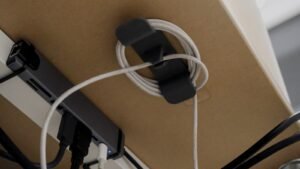
Yes — clips are commonly used on the underside or back edge of a desk as well as walls and baseboards, anywhere a flat, clean surface is available to mount them.
Next Steps
Ready to buy some? See our Best Cable Management Clips picks for a full comparison of top-rated options.