An under-desk cable tray solves a specific problem: getting a power strip and its tangle of adapters off the floor and within arm’s reach, instead of sitting in a pile you step around or hidden away in a box you can’t easily access. The install is usually a five-minute job, but the wrong choice on mounting style, weight capacity, or material can mean a tray that sags, falls, or traps heat under a loaded power strip.
Key Factors to Consider
Weight Capacity
Add up what’s actually going in the tray — a power strip, a couple of wall adapters, maybe a small hub — and check that against the tray’s rated capacity. Trays rated under 5 lbs can sag or pull loose under a fully loaded power strip.
Mounting Style: Clamp vs. Adhesive vs. Screw
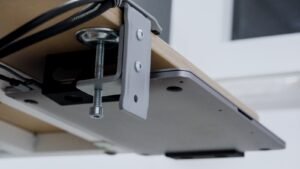
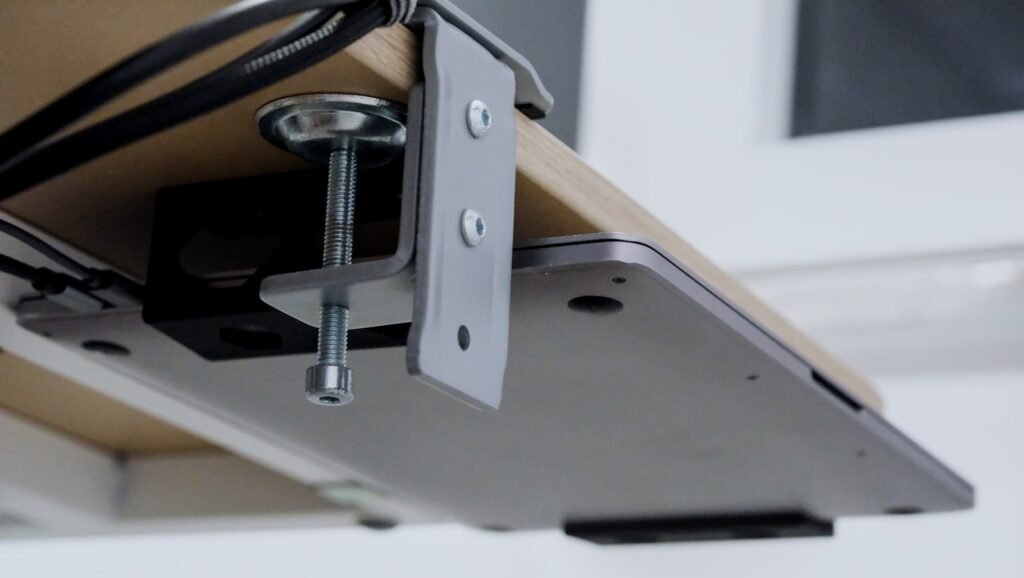
Clamp mounts are the most reversible — no marks, easy to move to a new desk. Adhesive mounts hold well on smooth surfaces but are semi-permanent once stuck. Screw mounts are the most secure but put permanent holes in the desk.
Length & Desk Width
Measure your desk’s width, not just where you think the power strip will sit. A fixed-length tray that’s too short leaves cables hanging past the end; an extendable tray adds flexibility if you’re unsure or might change desks later.
Material: Metal Mesh vs. Fabric vs. Plastic
Metal mesh and fabric both ventilate heat better than solid plastic, which matters if the tray is holding a power strip feeding anything with a real power draw. Solid plastic trays are cheaper but trap more heat underneath.
Ventilation & Heat Safety
A power strip generates some heat even under normal use. Open mesh or fabric designs let that heat escape; fully enclosed solid trays can trap it, especially in a tight space under a desk with limited airflow.
Common Mistakes to Avoid
- Underestimating the load. A power strip plus several wall adapters adds up fast — check the tray’s rated capacity against the actual weight, not a guess.
- Choosing solid plastic for a heavy power draw. Enclosed plastic traps heat; mesh or fabric ventilates it away.
- Not measuring desk width. A fixed-length tray too short for the desk leaves cables hanging past the end, defeating the point.
- Going straight to adhesive on a rental. Adhesive mounts are semi-permanent — a clamp mount avoids the commitment if you might move.
Our Recommendations
If you’d rather skip the comparison shopping, these cover the most common situations. For the full lineup with pricing and ratings, see our Best Under-Desk Cable Trays guide.
Best Overall: No-Drill Metal Mesh Tray w/ Clamp Mount
A 4.7-star average across 3,200 ratings, the strongest combination of sample size and score here; open mesh ventilates heat from power strips and adapters.
Best for Heavier Loads: Yecaye 2-Pack Large Metal Tray
Rated for 12 lbs per tray, built for a fully loaded power strip plus adapters and a small hub, with sturdy metal construction that resists sagging.
Best Budget: Yecaye Clamp Mesh (Dual-Direction F-Clamp)
Matches the top pick’s price with a dual-direction clamp that adapts to different desk edge shapes, for a compact single-power-strip setup.
Frequently Asked Questions
How much weight can an under-desk cable tray hold?
It varies by model, from around 5 lbs on lighter trays up to 12 lbs or more on reinforced metal ones. Add up your power strip and adapters before buying, and choose a tray rated comfortably above that total.
Do I need to drill holes to install a cable tray?
No, most trays sold today use a clamp or adhesive mount specifically to avoid drilling. Screw-mount trays exist and are the most secure option, but they’re the exception rather than the default.
What size cable tray do I need for my desk?
Measure your desk’s width at the point where the power strip will sit. Most trays run 15-20 inches for a single power strip; wider desks or bigger cable loads may need a 30-36 inch model or an extendable tray.
Can an under-desk tray hold a power strip safely?
Yes, as long as the tray’s rated capacity comfortably covers the power strip’s weight plus whatever is plugged into it. Favor mesh or fabric designs over solid plastic for better heat dissipation.
Under-desk cable tray vs. cable box, which one should I use?
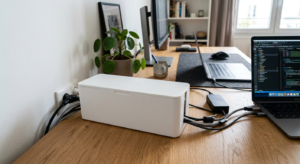
A tray mounts under the desk and keeps everything within reach; a cable box sits on the floor and fully encloses the power strip. Trays suit setups where you plug things in often; boxes suit a power strip you rarely touch.
Conclusion
An under-desk cable tray is one of the simplest upgrades in this whole cluster: five minutes of clamp installation and your power strip is off the floor for good. Measure your desk width and add up your power strip’s weight before you buy — that matters more than which specific tray you pick. See our Best Under-Desk Cable Trays for a Home Office in 2026 guide for the full lineup.