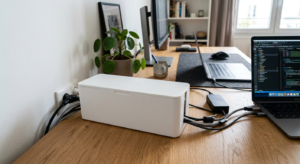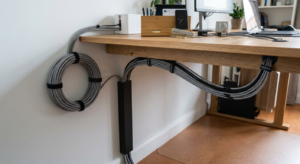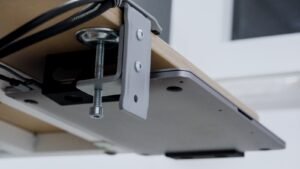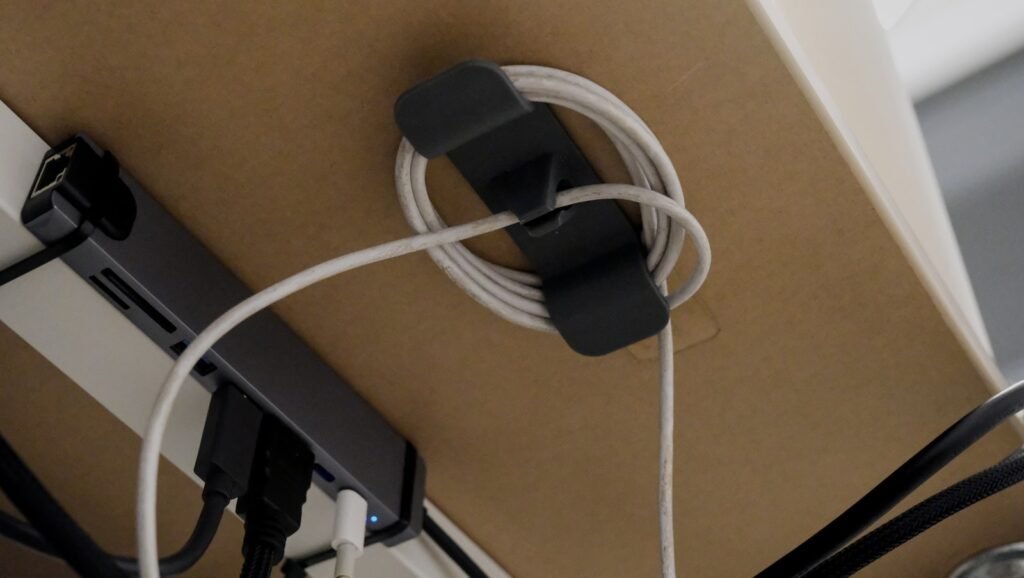
Both cable raceways and cable management clips hide cords along a wall or desk, but they solve the problem in very different ways. Here’s how the D-Line 157in Cord Cover Kit and SOULWIT Silicone Cable Holder Clips compare, so you can pick the right approach for your specific setup.
Quick Winner
Choose the D-Line Cord Cover Kit if you want a fully enclosed, finished look for a long, visible wall run. Choose SOULWIT Cable Clips if you need a fast, cheap fix for a few individual cables and don’t mind them staying partially visible between clips.
Comparison Table
| Spec | D-Line Cord Cover Kit | SOULWIT Cable Clips |
|---|---|---|
| Price | CAD 37.53 | CAD ~15-20 (3-pack) |
| Material | Rigid paintable plastic channel | Silicone |
| Coverage | 157 inches, fully encloses cables | Point clips along a path, cable visible between |
| Install time | 20-40 minutes for a full run | Under 5 minutes per clip |
| Rating | 4.4/5 | 4.6/5 (based on comparable clip products) |
Feature Comparison
Price
The raceway kit costs more upfront but covers a full 157-inch run with accessories included. Clips are cheaper per unit but you’ll need several for a comparable length, and total cost can come close depending on how many you need.
Concealment
A raceway fully hides the cable inside a closed channel — nothing is visible once the cover snaps shut. Clips only pin the cable at fixed points, leaving it visible in the open spans between clips.
Installation Effort
A raceway install takes real planning — measuring, cutting, cleaning the surface, and snapping the cover on. Clips are nearly instant: clean the spot, stick the clip, press the cable in.
Flexibility to Change Later
Removing cables from a raceway just means popping the cover back off. Removing a cable from a clip setup is just as easy, but repositioning clips themselves damages their adhesive.
Durability Over Time
A raceway’s rigid channel protects cables from being crushed or pinched underfoot or by furniture, since the cable sits fully enclosed. Clips leave the cable exposed between mounting points, so a run that crosses a high-traffic area is more vulnerable with clips than inside a sealed raceway.
Best Combined Use
The two aren’t mutually exclusive — a common setup uses clips to route cables under and around a desk, then transitions into a raceway for the final visible run up a wall or along a baseboard where full concealment matters most.
Pros and Cons
D-Line Cord Cover Kit
- Fully hides cables in an enclosed channel
- Paintable to disappear into any wall color
- Best for long, highly visible runs
SOULWIT Cable Clips
- Much faster and cheaper to install
- No cutting or measuring required
- Better for a handful of individual cables, not a full concealed run
Who Should Buy D-Line Cord Cover Kit
Choose the raceway if you have a long, clearly visible cable run — along a baseboard, up to a wall-mounted TV, or across an open wall — and want it to disappear completely rather than just be tidied up.
Who Should Buy SOULWIT Cable Clips
Choose cable clips if you’re dealing with a handful of cables on or under a desk that just need to stay in place, and full concealment isn’t the priority — speed and low cost matter more here.
Final Verdict
For a genuinely hidden, finished look on a long wall run, the D-Line Cord Cover Kit is worth the extra time and cost. For quick, everyday cable control on a desk, the SOULWIT Cable Clips get the job done in minutes at a fraction of the price. Many home offices end up using both — clips for the desk, a raceway for the visible wall run.
Frequently Asked Questions
Can I use both a raceway and clips in the same setup?
Yes — many home offices use clips for cables on or under the desk and a raceway for the longer, more visible run to the wall outlet.
Which is cheaper, a raceway or cable clips?
Individual clips are cheaper per unit, but a full raceway kit that covers a long run in one purchase can end up costing less than buying many individual clips for the same length.
Which looks more finished, a raceway or clips?
A raceway gives a fully enclosed, finished look since the cable is hidden entirely. Clips leave the cable visible between mounting points, which is fine for under-desk use but less polished on an open wall.
Which is easier to install?
Cable clips are much faster — each one takes under a minute. A full raceway install involves measuring, cutting, and careful surface prep, typically taking 20-40 minutes for a complete run.